Stress is an unavoidable part of dairy farming. Even with excellent nutrition and management, dairy cows will experience challenges throughout their lifetime that require them to adapt.
From calving and regrouping to heat stress, feed variability and digestive upsets, these challenges can influence a cow's health, productivity and reproductive performance.
But why can a well-fed, well-managed cow still underperform during periods of stress?
The answer lies partly in how the cow's body responds to stress and, more specifically, how it changes the way nutrients are prioritised and used.
Stress is inevitable, but how cows respond matters
Dairy cows encounter a range of stressors throughout their productive lives. Some are part of normal management, such as transition, calving, dry-off and changes in feed or grouping. Others, including disease, digestive disturbances, heat stress and accidental feed restriction, may be less predictable.
While good management aims to minimise these challenges, eliminating stress entirely is not possible.
When cows experience stress, the effects can become visible through reduced feed intake, lower milk production, loss of body condition or increased susceptibility to disease and disorders.
However, these physical changes are linked to a series of internal responses that alter how the cow's body functions.
What happens inside a cow during stress?
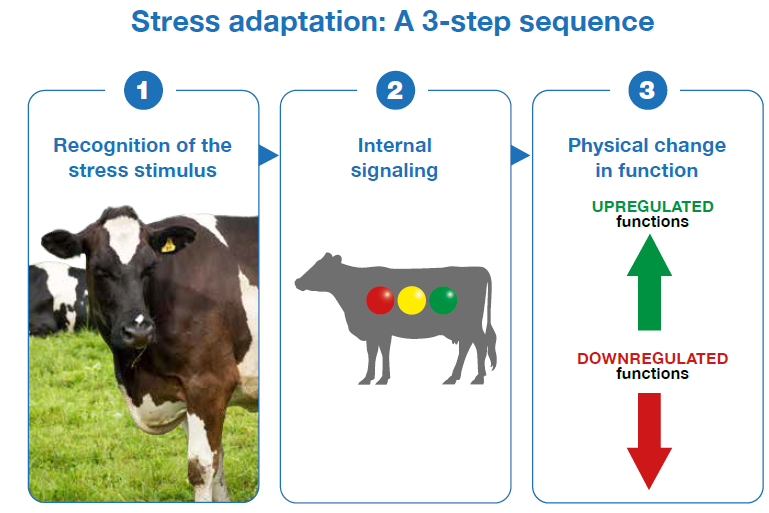
When a cow encounters a stressor, her body initiates an adaptive response designed to help her cope with the challenge.
This process involves three key stages:
Recognition of the stress stimulus: Through external and internal sensing, a cow recognises a challenge that requires a response.
Internal signalling: Signals generated within the body coordinate the response.
Physical changes in function: The activity of different cells, organs and bodily systems increases or decreases to help the cow adapt.
One important hormone involved in this process is cortisol, which plays a key role in coordinating the body's response to stress.
Cortisol, alongside other hormones, influences how different cells and organs take up and utilise nutrients. Cortisol promotes some bodily systems to increase their activity and nutrient requirements, while it inhibits activity in others.
This redistribution of nutrients between competing bodily functions is known as nutrient partitioning.
What is nutrient partitioning?
Nutrient partitioning describes how nutrients are prioritised among different cells, organs and bodily systems. In a dairy cow, nutrients are required to support several important functions simultaneously.
Mammary cells require nutrients for milk production, ovarian cells need nutrients to support reproductive function, and white blood cells require nutrients to maintain immune function. Meanwhile, vital organs, including the heart, lungs, liver and kidneys, must continue functioning normally.
Under normal conditions, hormones help regulate how nutrients are distributed between these competing demands.
For example, during early lactation, hormonal signals encourage the cow to direct nutrients towards producing high volumes of milk. Similarly, reproductive hormones influence how nutrients are used to support ovulation, oestrus and pregnancy.
However, when a cow experiences stress, these biological priorities can change.
How does stress affect nutrient requirements and use?
A dairy cow generally prioritises energy use in the following order: maintenance, foetal development, growth, lactation, reproduction and finally, body condition.
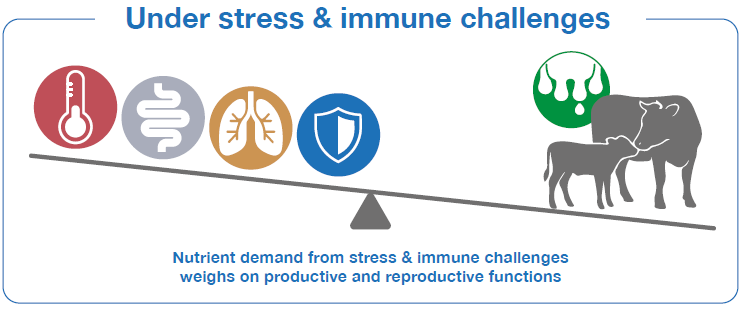
During periods of stress or immune challenge, the body's immediate response becomes a greater priority.
Nutrients are redirected towards the cells, organs and bodily systems needed to respond to the challenge. As these systems demand more nutrients, fewer may be available to support productive and reproductive functions.
This can have consequences for milk production, growth, fertility and body condition.
Importantly, the cow's nutritional requirements for productive functions have not disappeared. Instead, the nutrients diverted away from productive functions to support new priorities under stress.
Why does nutrient partitioning matter on farm?
Nutrient partitioning explains why dairy cows experience reductions in performance during stressful periods, even when they continue to receive a well-balanced diet.
A cow experiencing stress still requires nutrients for milk production, reproduction and maintenance. However, her body may prioritise nutrients towards managing the immediate challenge rather than supporting these productive functions.
The greater the demands associated with responding to stress, the greater the potential nutritional cost to the cow. This highlights why managing both the frequency and severity of stress events is important.
Although some challenges are unavoidable, reducing unintended stressors such as digestive disturbances, disease and management-related disruptions can help minimize the demands placed on the cow.
Supporting cows through these periods is therefore an important consideration when aiming to maintain health, productivity and reproductive performance.
The key takeaway: Stress changes the cow's priorities
Stress does more than influence a cow's behaviour or feed intake. It changes how her body functions and where nutrients are directed.
Through hormonal signalling, the cow adjusts the activity and nutrient requirements of different bodily systems, prioritising those needed to respond to the immediate challenge.
As a result, fewer nutrients may be available for milk production, growth or reproduction.
Understanding these changes helps explain why periods of stress can have a significant impact on dairy cow performance, even under good nutritional and management conditions.
Ultimately, the nutritional cost of responding to stress is an important factor in determining how well a cow can maintain her productive potential.
Supporting dairy cows through periods of stress with UltraSorb
While stress cannot always be avoided, supporting a cow's ability to cope with nutritional and environmental challenges is an important part of maintaining performance.
Volac's UltraSorb is a mycotoxin remediator and gut health support solution, designed to help dairy cows manage the challenges associated with mycotoxins and support gut health. Specifically, research shows that cows perform better and develop lower levels of immune-linked stress when fed UltraSorb during mycotoxin challenges.
By helping address mycotoxin challenges and gut health disruptions, UltraSorb represents a proactive nutritional approach to supporting cow health and productive potential during periods of stress.
Find out more about how UltraSorb could support your herd.